

Table of Contents
- What Ethical Sourcing of Jasper Artifacts Actually Means
- Jasper's Geological Origins and the Geography of Extraction
- How to Identify Ethically Sourced Crystals and Jasper Points
- Labor, Fair Trade, and Supply Chain Transparency in Stone Sourcing
- Sustainable Practices in Lapidary Arts and Artisanal Mining
- Cultural Heritage, Archaeological Integrity, and Replica Identification
- How to Vet Wholesalers and Verify Jasper Artifact Provenance
- Conclusion: Building a Collection with Conscience
- Frequently Asked Questions
Last Updated: September 26, 2026
What Ethical Sourcing of Jasper Artifacts Actually Means
Ethical sourcing of jasper artifacts is the practice of acquiring stone tools and points in a way that protects the people who mine the material, the environments it comes from, and the cultural record it belongs to. It is not a single certificate or a sticker on a box. It is a chain of decisions, from the quarry to your display shelf, and every link matters.
At Paleo Poet, we shape hand-knapped points from obsidian, jasper, and chert, and we write an original poem to live alongside each one. That work puts us at the awkward end of this conversation: we handle raw stone, so we have to ask where it came from. Below, we walk through what responsible sourcing looks like in practice, how to spot a genuine jasper point, and how to vet the people who sell them to you.
Most guides on this topic stop at "buy from a reputable dealer." That advice is useless to a collector holding a card at a gem show. What you actually need is a set of questions you can ask, and a sense of which answers hold up. The eight sections ahead give you exactly that.
Jasper's Geological Origins and the Geography of Extraction
Jasper is a cryptocrystalline form of quartz, meaning its crystals are too fine to see without magnification. It forms when silica-rich fluids infiltrate sedimentary or volcanic rock and slowly harden over long spans of time. Iron oxides and other trace minerals give it the reds, ochres, greens, and banded browns that collectors prize.
That geology dictates geography. Jasper appears in ancient volcanic belts, iron formations, and river gravels across the world, and the character of a stone often tells you something about where it formed. Banded red jasper from iron-rich sedimentary basins looks different from the waxy green material found in some volcanic deposits.
For a collector, this matters for one reason: geological origin is the first clue to provenance. If a seller claims a point is "Montana jasper" but the color, banding, and surface texture match material from another continent, that is a question worth asking. You do not need to be a mineralogist. You need to notice when the story and the stone disagree.
The U.S. Geological Survey mineral resources program maintains public information on where industrial and decorative stone materials occur, which is a reasonable starting point for understanding regional stone character.
How to Identify Ethically Sourced Crystals and Jasper Points
Knowing how to identify ethically sourced crystals and jasper points comes down to documentation, not vibes. A responsible seller can tell you where the material was collected, who collected it, and under what conditions. A seller who cannot answer those questions is not necessarily dishonest, but they are asking you to take a lot on faith.
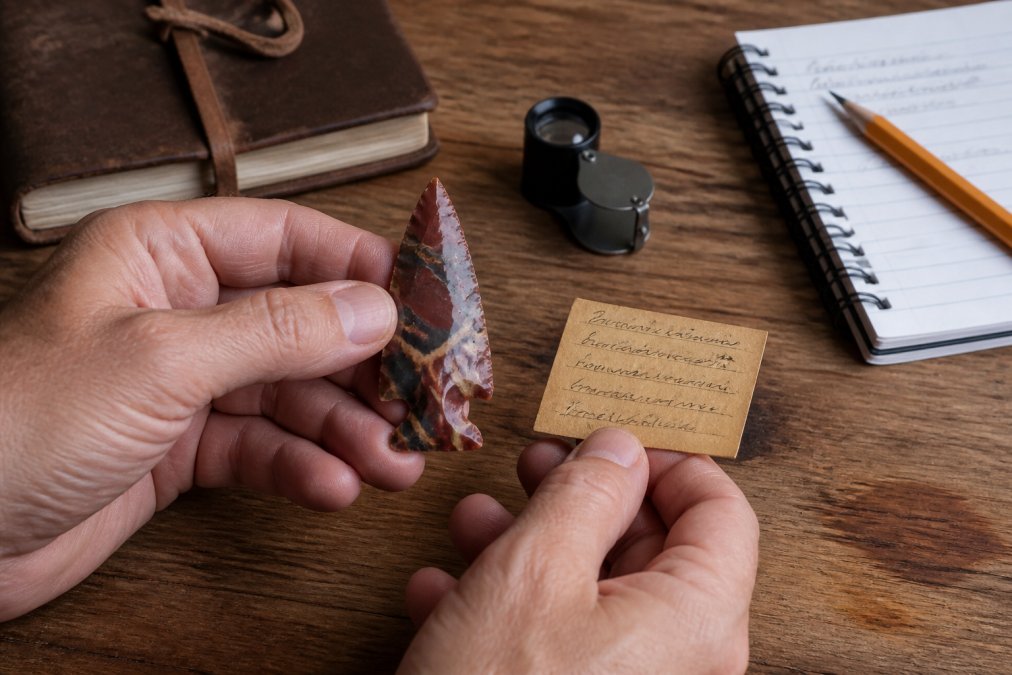
Start with the paperwork. A certificate of authenticity is only as good as the person issuing it, so look for specifics: a named source, a date, a location, and a description of the material. Vague certificates that say "genuine jasper" without more detail tell you almost nothing.
Then look at the stone itself. Hand-knapped jasper points carry flake scars, a bulb of percussion, and irregular edges that reflect the maker's hand. The lapidary processes behind a genuinely knapped point leave marks that a molded or machine-cut replica cannot reproduce. Run your thumb along the edge. Real knapping produces a slightly wavy, uneven profile. Mass-produced replicas tend to be suspiciously uniform.
A few things to check:
- Flake scars that radiate from a single strike point
- Slight asymmetry, which is normal in hand work
- Surface texture that feels like stone, not resin or ceramic
- Weight that matches the density you would expect from quartz-family material
Labor, Fair Trade, and Supply Chain Transparency in Stone Sourcing
Fair trade in stone is harder to verify than fair trade in coffee, and that gap is where most of the problems hide. Coffee has certification bodies, cooperative structures, and a mature auditing ecosystem. Decorative stone and knappable material often move through informal channels where labor conditions are invisible to the buyer.
Artisanal mining, where individuals or small groups extract material by hand, is common in the stone trade. It can be a legitimate livelihood or an exploitative one, and the difference usually comes down to whether workers are paid fairly, whether they are exposed to unsafe conditions, and whether children are involved. None of that is visible in a finished point.
Supply chain transparency is the practical answer. A transparent seller can name the region, the supplier, and the arrangement under which the material changed hands. That does not require a blockchain. It requires a seller who has actually asked.
The International Labour Organization publishes guidance on child labor and hazardous work that applies across mining sectors, and it is a useful reference when you want to understand what "fair labor" means in concrete terms rather than as a marketing phrase.
What most buyers miss is that transparency is a spectrum, not a binary. A seller who knows their material comes from a specific region and a specific supplier is already ahead of one who buys "assorted jasper" by the kilogram with no idea where it originated.
Sustainable Practices in Lapidary Arts and Artisanal Mining
Sustainable practices in lapidary arts and artisanal mining focus on reducing waste, limiting environmental damage, and keeping extraction at a scale the land can absorb. Stone extraction has an ecological footprint. It disturbs ground, uses water, and generates dust and tailings. The question is not whether an impact exists, but whether anyone is managing it.
On the mining side, small-scale extraction that avoids heavy machinery, limits the area disturbed, and rehabilitates worked ground is far less damaging than industrial quarrying.
On the lapidary side, sustainable practice looks like this:
- Using the full stone rather than discarding offcuts
- Recycling water in cutting and grinding
- Choosing abrasives and polishes with lower toxicity
- Avoiding unnecessary chemical treatments that shorten a stone's life
Cultural Heritage, Archaeological Integrity, and Replica Identification
Archaeological integrity is the principle that artifacts removed from their original context destroy information that can never be recovered. This is the part of the conversation that commercial crystal sellers routinely skip, and it is the part that matters most.
How to Vet Wholesalers and Verify Jasper Artifact Provenance
Vetting a wholesaler is a research task, and it takes about an hour. Provenance verification means confirming that the story a seller tells you about a stone's origin holds together across documents, the physical object, and the seller's own consistency over time.
| Question to Ask | What a Good Answer Looks Like | What Should Concern You |
|---|---|---|
| Where was this material collected? | A named region or deposit | "Various sources" or no answer |
| Who collected or supplied it? | A named supplier or workshop | Refusal to name anyone |
| Is the piece modern or archaeological? | A clear, immediate answer | Ambiguity or a change of subject |
| Has the stone been treated? | Full disclosure of any treatment | "It's all natural, don't worry" |
| Can you document the chain of custody? | Photos, receipts, or a written record | "We don't keep records like that" |
Conclusion: Building a Collection with Conscience
Every collector eventually faces the same tension: the pieces that move you most are often the ones with the murkiest history. Resolving that tension means deciding what you are willing to know about the objects you keep.
Frequently Asked Questions
What does it mean for a crystal or stone artifact to be ethically sourced?
It means the stone was extracted, processed, and traded without harming workers, communities, or ecosystems, and that its journey from mine to market can be traced. For jasper artifacts, ethical sourcing covers fair pay for artisanal miners, safe labor conditions, minimal environmental disturbance, and respect for cultural heritage. Collectors should expect clear provenance documentation and a seller willing to explain where the raw material came from and how it was worked.
How can collectors verify the origin of jasper artifacts?
Start with a certificate of authenticity that names the geological origin, the mining region, and the lapidary or knapping process used. Ask the seller for the name of the mine or mining cooperative, and cross-check the stone's visual and physical traits against known jasper varieties. A responsible seller will welcome questions about raw material traceability and can describe the supply chain in specific terms rather than vague assurances.
How does ethical sourcing differ from fair trade in the stone industry?
Fair trade focuses on fair wages, safe conditions, and community benefits for workers. Ethical sourcing is broader: it adds environmental stewardship, supply chain transparency, and cultural heritage protection. A fair-trade jasper artifact might still come from a mine with poor ecological practices, while an ethically sourced one should address both human and environmental impact. Look for sellers who speak to both, not just one.
Are there specific certifications for ethically sourced stone artifacts?
There is no single universal certification for jasper artifacts. Some suppliers use third-party audits, chain-of-custody programs, or membership in responsible mining initiatives. Others rely on direct relationships with artisanal mining cooperatives and publish their sourcing policies. Because standards vary, the most reliable signal is a seller who can name their mines, describe their auditing process, and provide documentation on request.